
EarVac: Negative Pressure Wound Therapy Device for Improved Microtia Surgery Recovery
Microtia is a congenital condition in which children are afflicted (usually unilaterally) with a malformed or absent ear. The team is developing a device to assist with post-surgical therapy.
Project Overview
Microtia is a congenital condition in which children are afflicted (usually unilaterally) with a malformed or absent ear. The most common remedy for this condition is reconstruction surgery, in which autologous rib cartilage is formed into a new auricle and inserted underneath the skin flap of the affected ear. Complications following the operation are not uncommon, and include hematoma, skin necrosis, cartilage resorption, and scarring. Surgeons currently do not have a one-device method which conveniently reduces the risk of these complications and maintains a wound drain, which is routinely placed on the patient and manually maintained following microtia reconstruction. Negative pressure wound therapy (NPWT) is a gold-standard technique for augmenting healing on both open wounds and closed incisions. Devices (pre-assembled dressings and vacuum units) currently exist for this purpose, but are not specialized for the delicate nature of the ear. The use of NPWT in auricle reconstruction is not well explored, but is predicted to have positive outcomes on reducing complication risk. These benefits include increasing the speed of healing and assisting in maintenance of the shape of the new auricle. In addition, NPWT’s use of a vacuum unit is enticing for compatibility with a wound drain, which can be automated when using the same vacuum unit as the NPWT dressing. The EarVac team has begun fabrication of a novel NPWT device which will conform to the newly reconstructed auricle, consistently apply negative pressure to the closed incision, remove wound exudate, and allow automation of a wound drain. The EarVac will be tested according to FDA guidelines to ensure its safe and effective use. Current testing suggests the EarVac’s protective covering should be made of a more industrial material. Testing must still be conducted to assess the viability of vacuum sealing of the auricle. If proven viable, the EarVac could redefine microtia surgery recovery—accelerating healing while eliminating the burden of manual wound drainage.
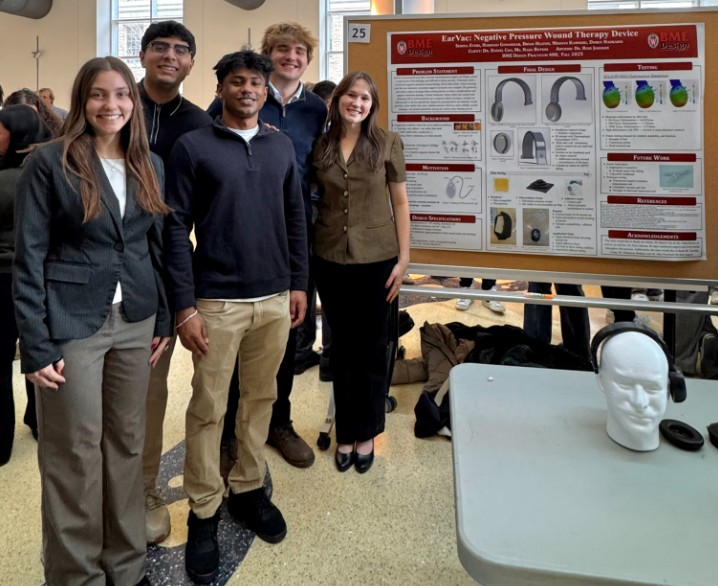
Team Picture
Files
- Final Notebook (April 29, 2026)
- Final Report (April 29, 2026)
- Final Poster Presentation (April 23, 2026)
- Executive Summary (April 17, 2026)
- Preliminary Presentation (February 9, 2026)
Contact Information
Team Members
- Bryan Heaton - Team Leader
- Meghan Kaminski - Communicator
- Serena Evers - BSAC
- Dhruv Nadkarni - BWIG
- Harshad Gunasekar - BPAG
- Muhaison Ibrahim
Advisor and Client
- Dr. Russ Johnson - Advisor
- Ms. Nada Botros - Client
- Dr. Daniel Cho - Alternate Contact
Related Projects
- Spring 2026: EarVac: Negative Pressure Wound Therapy Device for Improved Microtia Surgery Recovery
- Fall 2025: HeadVac: Negative Pressure Wound Therapy Device for Improved Microtia Surgery Recovery